FPS
- Est. average
- 1% low
- Rendered avg.
- VRAM used / avail.
GPU FIELD REPORT / PROJECTED
Steam Deck is borderline in this model: 31 FPS average at 720p/800p approximation Low with Balanced upscaling; real PC compatibility is unconfirmed.
Interactive Build & FPS Telemetry
Rockstar Games has not published official GTA 6 PC system requirements. All results are projections based on PS5 and Xbox Series X hardware and RAGE engine scaling.
Optional. GPU detection runs locally on this device only. You can enter your parts manually — CPU, RAM, and storage are always selected manually. Select your GPU manually under Configure your build. On Windows, open Task Manager → Performance or run dxdiag to find your GPU and CPU. See the guide to Windows (Task Manager / dxdiag): check your GPU & CPU.
Detection wrong or missing? Manually select your exact GPU, including the laptop variant where available. If the model is missing, choose the closest tier for a rough comparison only; check dedicated VRAM and the laptop graphics power limit. On dual-GPU laptops, select the discrete NVIDIA or AMD GPU rather than integrated graphics.
These are model estimates. Official GTA VI PC requirements are unannounced.
For a 30 or 60 FPS target, compare rendered average FPS at the desired resolution and preset, then use the 1% low to judge likely stutter. Generated frames (Frame Generation) only improve displayed smoothness and do not double base input responsiveness.
| Resolution | Medium | High | Recommended |
|---|
Scores use at least the High preset to show where higher settings would hit a limit.
No Immediate Upgrade Required
The PS5 and Xbox Series X baseline uses RDNA 2 graphics at approximately 10.28–12 TFLOPS, an 8-core Zen 2 CPU, 16 GB of unified memory, and custom high-speed SSDs with Gen4-class I/O. The PS5 uses a custom SSD design, and Xbox Series X uses a custom NVMe SSD. Hardware scores scale this baseline for projected RAGE engine workloads.
Actual PC performance, requirements, graphics features, and compatibility will depend on Rockstar Games’ PC implementation. Laptop and handheld results also vary with power limits, cooling, and shared memory allocation.
All numbers are model projections, not official Rockstar data or PC benchmarks. They use the default configuration of the interactive calculator above: Steam Deck APU - Custom RDNA 2 8 CU · Steam Deck APU - Zen 2 · 16 GB system RAM · NVMe PCIe 3.0 SSD · Balanced upscaling · Frame Generation Off.
The 720p model is an 800p approximation, not a native 800p measurement. The 1080p rows are docked projections.
The projected verdict describes the build at each resolution using the model's recommended preset, not a verdict for each row. The primary limit is the model's High or Ultra diagnostic; VRAM is estimated for the listed row. The static table describes the default build even if you change the interactive calculator.
| Resolution & Preset | Projected Avg FPS | Projected Range | 1% Low | Projected Verdict (build) | Primary Limit / Note |
|---|---|---|---|---|---|
| 720p (800p approximation) Low | 31 FPS | 27–36 FPS | 22 FPS | Borderline · Low recommended | Graphics memory headroom; VRAM 4.1 / 4 GB (modeled) |
| 720p (800p approximation) Medium | 21 FPS | 18–25 FPS | 12 FPS | Borderline · Low recommended | Graphics memory headroom; VRAM 5.2 / 4 GB (modeled) |
| 720p (800p approximation) High | 14 FPS | 12–16 FPS | 6 FPS | Borderline · Low recommended | Graphics memory headroom; VRAM 6.7 / 4 GB (modeled) |
| 720p (800p approximation) Ultra | 7 FPS | 6–8 FPS | 2 FPS | Borderline · Low recommended | Graphics memory headroom; VRAM 8.7 / 4 GB (modeled) |
| 1080p (docked) Low | 16 FPS | 13–18 FPS | 9 FPS | Upgrade Needed · No playable preset | Graphics memory headroom; VRAM 5 / 4 GB (modeled) |
| 1080p (docked) Medium | 11 FPS | 10–13 FPS | 5 FPS | Upgrade Needed · No playable preset | Graphics memory headroom; VRAM 6 / 4 GB (modeled) |
BUILD PROFILE
Projections for the preset build above; no game benchmark or confirmed PC support.
| Specification or setting | Projection |
|---|---|
| Graphics hardware | 8-CU RDNA 2 APU · shared memory |
| Reference CPU | Steam Deck APU - Zen 2 |
| System RAM / storage | 16 GB / nvme-gen3 |
| 720p/800p approximation low · balanced | 31 FPS avg · 27–36 FPS range · 22 FPS 1% low |
| Model video memory | 4.1 / 4 GB used / available |
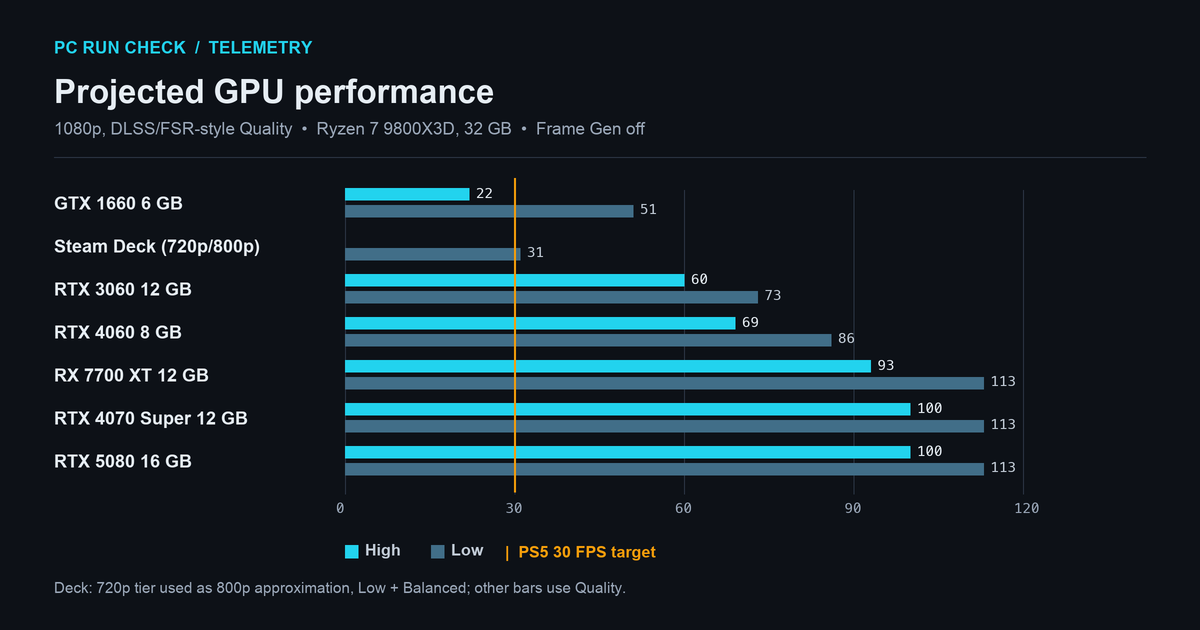
The Steam Deck preset uses its custom APU, 16 GB of shared RAM, an NVMe Gen3 SSD, the estimator's 720p resolution tier and Balanced upscaling. At Low, the model projects a 31 FPS average, a 27–36 FPS range and a 22 FPS 1% low, with a Borderline verdict. The 720p tier is used as an approximation for the handheld's 800p screen; it is not a native 800p benchmark. No generated frames are included.
This is not proof that GTA VI can run on the device. Rockstar has not announced a PC release or official PC requirements, and no Steam Deck or Proton compatibility has been confirmed. The estimate models graphics and CPU constraints only; it cannot establish that a launcher starts, that an operating system is supported or that any eventual online component works.
Valve’s Steam Deck specifications describe an AMD Zen 2 CPU and an RDNA 2 GPU in the custom APU. The GPU has eight compute units, and the APU is specified with a 4–15 W power range. That whole-chip budget is shared between CPU and graphics work, unlike a desktop card with its own much larger allocation. The model uses a handheld-specific database entry; it does not treat an RTX or Radeon desktop board as an equivalent part.
Sustained performance also depends on battery state, temperature, cooling, system settings and the workload. An outdoor scene with many simulated entities can stress a different part of the chip from an indoor scene dominated by lighting. Do not infer a constant power draw or a fixed frame rate from the headline average. Waiting for real device captures is essential once an actual PC version exists.
The Deck has four CPU cores and eight threads. Dense crowds, traffic, physics and background services can create a CPU constraint even when the display resolution is modest. Reconstruction lowers some GPU rendering work; it does not eliminate simulation. Our model includes a crowd-related adjustment for lower-core configurations, but that is an approximation, not a reproduction of Rockstar's scheduling or actual city density.
The estimated 1% low is useful as a warning about slower frames, especially for a handheld where an uneven 30 FPS can feel worse than a stable cap. It is still a calculated value. If a real game arrives, look for frame-time graphs from demanding scenes, note the power setting and compare both average and low performance over more than a brief clip.
The Deck includes 16 GB of unified LPDDR5 memory used by both the CPU and GPU. The operating system and other processes also need space. The estimator assigns a simplified graphics budget for its handheld entry rather than treating all 16 GB as exclusively available to textures. In the default scenario it reports approximately 4.1 GB modeled demand against a 4 GB available graphics budget; real allocation and operating-system behavior may differ.
That distinction helps explain why high texture settings are uncertain even at a small screen resolution. Unified memory can move data without the same discrete-card arrangement, but it is still finite and bandwidth is shared. The exact reservation shown in a firmware or operating-system interface does not by itself describe every dynamically usable byte. Use independent measurements of the eventual game before judging a specific setting.
SteamOS is Linux-based, and many Windows games rely on Valve's Proton compatibility layer. A compatible executable is only one piece of the path: any Rockstar Launcher integration, authentication, platform requirement or anti-cheat system must also work in that environment. As Valve’s Proton documentation explains, some games using BattlEye or other anti-cheat can support Linux through Proton when the developer enables and maintains the relevant configuration; others do not. We do not know which, if any, such software a future GTA VI PC release will use or whether it will be enabled for SteamOS.
Windows on a Deck is a separate software setup with its own drivers and power behavior, not proof that a future game will be supported. Avoid treating community speculation as a compatibility announcement. Check Rockstar and Valve's official compatibility information after a PC release, then look for a reproducible test of the current game version and launcher. A hardware FPS estimate cannot answer those questions.
The Steam Deck OLED has a 90 Hz display, while the LCD model uses a 60 Hz display. A 30 FPS cap can divide evenly into either refresh rate and may give more consistent pacing when the device can hold it. The cap itself cannot prevent dips below the target, and a 90 Hz panel does not turn a 30 FPS workload into 90 rendered frames. OLED and LCD variants can also differ in efficiency, battery and display characteristics.
If the eventual game is compatible, start with the lowest demanding settings and a cap that the device can sustain in difficult areas. Adjust one control at a time and observe heat, fan behavior, battery life, visual clarity and frame times. Upscaling can help preserve output resolution but may trade away detail on small text or distant geometry. Availability of a particular technology is unconfirmed.
The ROG Ally with Ryzen Z1 Extreme uses a different APU, operating system and power configuration. In many scenarios a higher available power budget can increase performance, but results depend on the selected mode, cooling and plugged-in versus battery operation. Comparisons should use the same game version, output resolution, scene, settings and reconstruction mode. The Ally's display or peak specifications alone do not establish a fair result.
The higher-wattage ROG Ally Z1 Extreme and Legion Go in the live checker may have more projected settings headroom than Steam Deck at the same resolution and scaling mode, depending on power and cooling. Use the Windows hardware guide for a Windows handheld and the projected requirements for the model's assumptions; GTA VI PC availability and handheld compatibility remain unconfirmed.
The Deck may instead appeal for its controls, interface or portability. Neither handheld has confirmed compatibility with an unannounced GTA VI PC release. Compare the software path as carefully as the hardware, and consider streaming from a supported platform only after verifying the platform's own current requirements and terms.
The GTX 1660, RTX 3060 and RTX 4060 pages use desktop configurations and 1080p scenarios, so their values are not direct handheld comparisons. See the requirements guide for assumptions and open the full checker to change RAM, resolution and storage. Reassess when official PC information and independent handheld testing are available.
FIELD NOTES / FAQ
A PC edition and Steam Deck compatibility have not been announced. The displayed figure is only a hardware projection.
The model projects 31 FPS average using its 720p tier as an 800p approximation with Balanced upscaling; this is not a native 800p benchmark.
That is unknown. Any launcher, authentication and anti-cheat used by a future PC version would need compatible support.
No. Its LPDDR5 memory is shared by the CPU, GPU and system; the model uses a simplified graphics-memory budget.
A 30 FPS cap divides evenly into a 90 Hz refresh, but the hardware must still sustain that rate for even pacing.